

19 hours ago
Early observations from a participant with Stargardt disease offer a promising step in research into retinal implants, while researchers emphasise that formal clinical results are still to come.
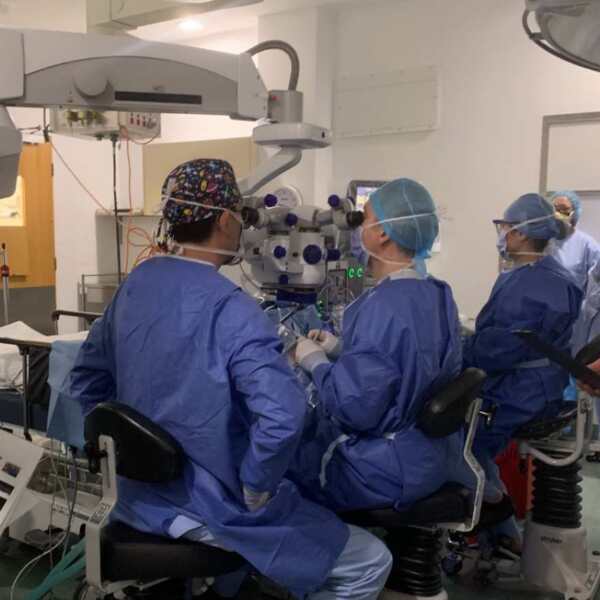
Researchers at Sydney Eye Hospital have reported encouraging early observations from an Australian participant in a clinical trial investigating whether an electronic retinal implant could help restore some functional vision in people with inherited retinal disease (IRD).
The participant, who is living with Stargardt disease, was reportedly able to recognise a letter during his first rehabilitation session and read a word during his second.
While these observations represent a positive early step, researchers have emphasised that they are not formal clinical-trial results and cannot yet establish how effective the technology may be.
The trial, known as PRIMAlia, is investigating an experimental retinal implant system called PRIMA, which aims to provide a simplified form of central vision to people who have experienced significant vision loss due to retinal degeneration.
How does the PRIMA retinal implant work?
Inherited retinal diseases are a group of genetic conditions that affect the retina, the light-sensitive tissue at the back of the eye. These conditions can cause progressive vision loss and, in some cases, severe impairment of central vision.
Stargardt disease is one form of IRD that primarily affects central vision, making activities such as reading and recognising faces increasingly difficult.
The PRIMA system takes a different approach from treatments that target specific genetic mutations.
It uses a small electronic implant positioned beneath the retina, together with specialised glasses that capture and process visual information. The system is designed to stimulate surviving retinal cells and provide visual signals that the brain can learn to interpret.
Rather than restoring natural sight, the technology aims to provide a simplified, low-resolution form of central vision that may help with certain visual tasks.
Learning to interpret these signals requires rehabilitation and training.
An encouraging beginning, with important questions still to answer
The Australian study is being conducted at Sydney Eye Hospital, with retinal specialist Dr Matthew Simunovic involved in the research.
Dr Simunovic confirmed to Retina Australia that the reported letter and word recognition occurred during the participant’s early rehabilitation sessions.
“The reports of the participant seeing a letter in the first rehabilitation session and reading a word in the second came from those early rehabilitation sessions [and] are encouraging, but they are observations during training, not formal outcome results,” he explained.
He also confirmed that the participant continues to make encouraging progress.
The study includes formal assessments of visual function, which will provide a more rigorous understanding of the system’s safety and potential benefits.
Those results are not yet available as a published Australian research summary.
Dr Simunovic stressed that the experience of one participant cannot predict the results for others.
“This is a very early experience from one participant. It cannot yet tell us what another person might experience, or how much useful vision they might gain.”
This distinction is particularly important for people living with IRD and their families. Early progress in a clinical trial can be a meaningful source of hope, but it is not the same as evidence that a treatment is safe and effective for a wider patient population.
Why this research matters
There is currently no treatment available for many forms of inherited retinal disease, making research into new approaches particularly important.
Much of the progress in IRD research has focused on treatments designed to slow degeneration, preserve remaining vision or address specific genetic causes.
Retinal implants represent another area of investigation: whether technology can help provide useful visual information after significant damage to the retina has already occurred.
The PRIMAlia study is an example of Australian researchers contributing to the development and assessment of emerging technologies for people affected by retinal degeneration.
Although it is too early to know how much benefit the PRIMA system may ultimately provide, the research is helping investigators understand its potential, its limitations and the rehabilitation required to use it.
For people living with IRD, progress does not always come in the form of an immediate treatment. It also comes through carefully conducted studies that build the evidence needed to determine which approaches may be safe, effective and suitable for different patients.
Is the Australian clinical trial recruiting participants?
Yes. The PRIMAlia study is currently recruiting participants in Australia.
People interested in learning more can discuss the trial with their ophthalmologist or contact the study’s Clinical Research Orthoptist:
Catherine Le
Email: catherine.le@sydney.edu.au
The research team can provide information about the study and assess whether someone may be eligible.
Importantly, interest in the trial does not mean that a person will meet the eligibility criteria. The early observations from the first participant should not be taken as an indication of the results another participant might experience.
People considering participation can request the approved participant information and consent materials through the study team’s usual enquiry process.
Further information is available through:
University of Sydney: New device hopes to restore vision lost from retinal degeneration
PRIMAlia clinical-trial registration (NCT07266584)
Progress through research
For people living with inherited retinal disease, developments such as these offer reason for cautious optimism.
The early observations from the Australian PRIMAlia participant are encouraging, but further assessment is needed before researchers can determine the system’s safety, effectiveness and potential role in clinical care.
Retina Australia welcomes continued research into approaches that may one day expand the options available to people living with IRD.
We remain committed to supporting research, sharing reliable information and helping our community understand emerging developments, including both their possibilities and their limitations.
This article is based on publicly available information about the PRIMAlia clinical trial and clarification provided directly to Retina Australia by Dr Matthew Simunovic. The PRIMA system remains investigational for the conditions being studied in the Australian trial. It is not an established treatment for Stargardt disease.
https://retinaaustralia.com.au/primalia-retinal-implant-stargardt-australian-trial/
Other News
Rewriting cell identity: meet Dr Daniel Urrutia-Cabrera, our 2026 Emerging Scientist
Daniel is working on a way to repair the...
CEO Message September 2026
Over the past few months, I have been thinking a lot about what exactly Retina Australia’s role can be in bringing our community together. One...

CEO Message August 2026
August has reinforced for me that one of Retina Australia’s greatest strengths is our ability to bring together people, expertise and resources around shared priorities to create greater impact....